
An electric kart fleet can be large enough on paper and still come up short at the third departure of a busy afternoon. Build a charging rotation around actual departure times. For every session, show which karts are ready, which are charging, and which are held back for checks. This gives the kart supplier, the track designer and the electrical designer one operating scenario to review.
Start with a busy block of sessions
Write down the departure times, driving time and turnaround between sessions. Include unloading, checks and movement between the pits and the charging area. Give each kart one status at each departure: ready, on track, charging, or unavailable. Count a kart as ready only when it meets the fleet supplier’s return-to-service criteria and has completed the operator’s checks.
Ask the supplier to demonstrate a rotation over several consecutive sessions under the operating assumptions you plan to use. Record the operating mode, starting charge, the point at which charging begins, and when the kart is expected to be available again. Confirm which readings the model provides. Sodikart’s documentation, for example, describes a fleet view showing charging status and battery charge level on supported equipment. Use these readings to check the schedule against actual operation.
Test the overlap between charging and departures
In an illustrative timetable, a venue has 12 karts assigned to a busy block and plans eight drivers at the next departure. Four karts are still charging. If one of the other eight is held back after a check, only seven are ready. This is a shortfall of one kart for that departure. The figures are illustrative and make no assumption about charging time or fleet size for a real venue.
Repeat the exercise with one charger unavailable and with a delayed return. Record which departure is affected, how many slots the operator plans to offer under those conditions, and when the schedule recovers. Where the fleet supplier offers approved removable batteries, keep a separate count of ready, in-use, charging and unavailable packs. Check both the kart and pack counts at each departure. Ask the supplier for the procedure and operating restrictions for the exact system.
Give the designer a plan and a simultaneous load schedule
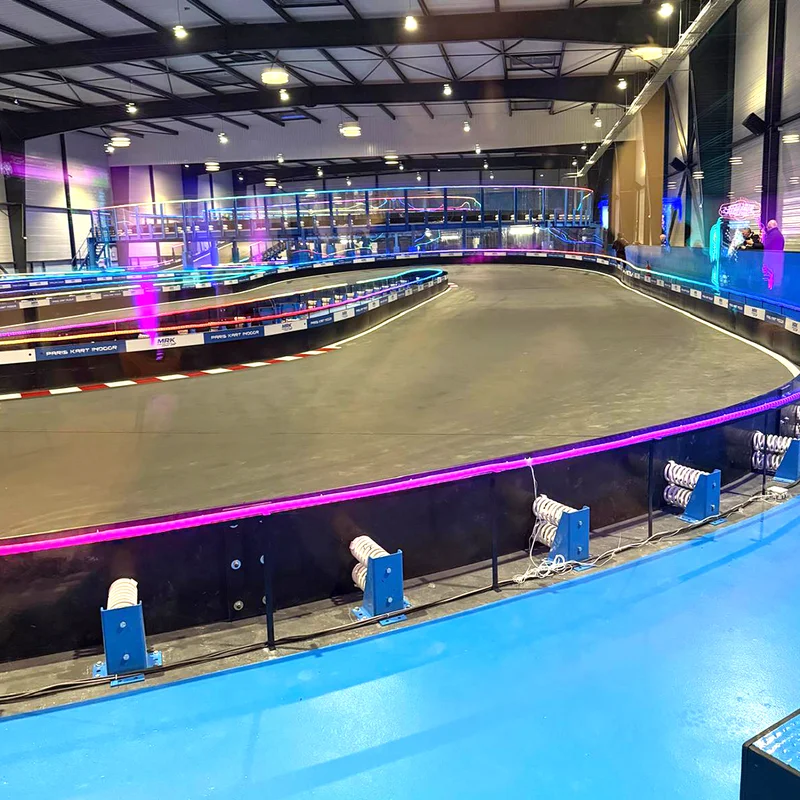
Mark the departure queue, return route, charging positions and staff access on the same drawing. Trace one kart from the end of a session to its next departure and check what movements coincide. On a multi-level track, identify the level of each position and the route between the pits and the charging area. Show where an unavailable kart waits for workshop assessment.
List the exact charger references and their manufacturer-stated electrical input requirements. Use your timetable to show how many units you intend to run at the same time. Give that information and the other coincident building loads to the electrical designer for review. Ask the venue’s designers and suppliers to confirm the location, connections and site requirements for the selected equipment before reserving space or placing an order.
Prepare two scopes for the quotation
Ask the fleet supplier to itemise karts, batteries, chargers, delivery, commissioning and the operating demonstration. Identify the site electrical installation separately. For the circuit, use the MRK track design service to coordinate the pit layout and the operations guide to connect the rotation with bookings and staffing.
The MRK simulator estimates selected track supplies excluding VAT. Transport, installation and resin application require separate pricing unless included in a specific offer. Confirm applicable taxes with the supplier. To request a track quotation, send the building plan, fleet and charger references, proposed sessions and the areas still to be coordinated.
Manufacturer documentation
Sodikart fleet status and battery monitoring and CRG documentation on a model-specific removable battery option. Consult the current documentation for the exact fleet under consideration.