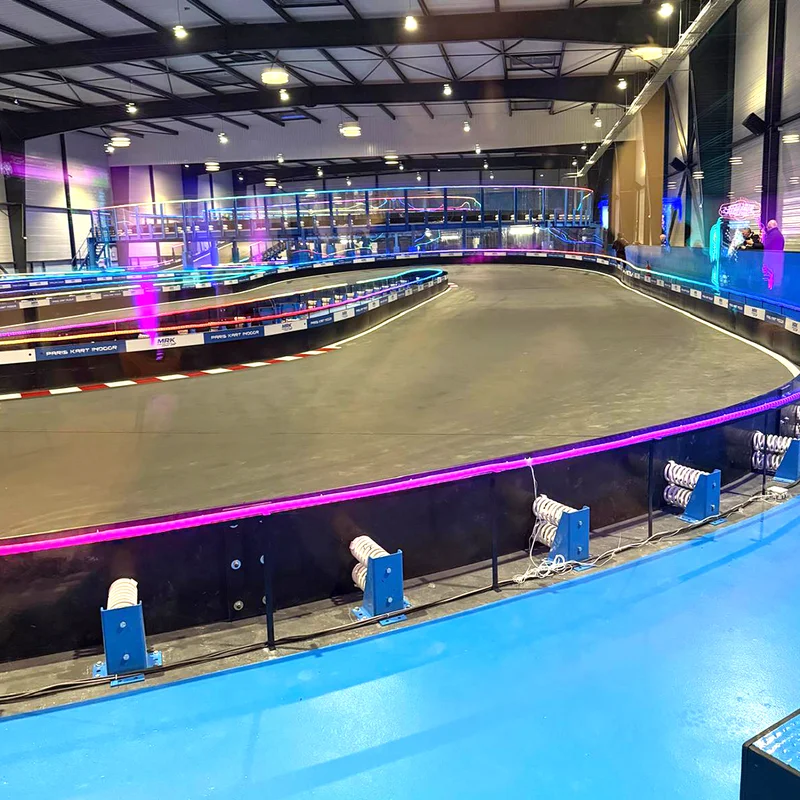
A maintenance opening can look like a simple gap on a karting plan. In use, it has two states: a continuous track edge when the opening is closed and a working route when the operator authorises access. Review both states before ordering barriers or fixing the equipment beside them.
Give each opening one job on the plan
Start with a specific task: bringing in cleaning equipment, reaching a service area or transferring a kart to the workshop. Assign an identifier to the opening, mark it on the current track plan and describe what should pass through it. If several tasks share it, list them separately. A location that suits a maintenance trolley may interfere with pit operations when it is used for a kart transfer.
Draw the opening on the protection plan alongside nearby corners, pit access and the adjoining barrier line. MRK assesses these elements together when discussing its karting barrier systems. Ask the designer and supplier to confirm how the opening fits the chosen system. Verify separately with the venue team whether the location interacts with any building escape route or accessibility requirement. A track opening should not be repurposed for those functions based on the concept drawing alone.
Review the closed position and the full movement
Ask the supplier to show how the closed assembly meets the adjacent barriers, how the closure is identified and what support it needs. On a second view, draw the entire movement of any hinged or sliding element. If the design uses a removable section, agree where it will be placed while the opening is in use and how it is returned to its designated position. Mark both the space required to operate the assembly and the useful passage available after it is opened.
Check the drawing against the building survey. A wall, nearby column protection, a cabinet or a change of level can alter the usable opening. Identify who confirms the system detail and who checks its interface with the support. Leave product dimensions, fixings and any structural changes to the relevant suppliers and specialists.
Walk through a realistic maintenance task
In a fictional venue, a maintenance team wants to move a floor scrubber from storage onto the track after the last session. The closed opening fits the barrier layout. In the open position, however, the panel occupies the space the operator needs to steer the machine from the corridor. The project team can compare a different position or a different opening arrangement on the same plan. The supplier and venue team then check the selected option against the actual equipment and operating procedure.
Record the equipment dimensions in its working configuration. Draw its approach, its turn and the position of the person operating it. Use the trial to check whether another door or route must stay available at the same time. Include the findings in the layout review with the track design team so that the decision is visible when the drawing is issued for quotation.
Assign control of the opening and its handover
Agree with the operator when the opening can be used, who authorises it and how staff verify its condition before resuming track activity. Use the supplier’s instructions when writing the venue procedure. Record the identifier, the permitted task, the person responsible for the closure check and the action to take if the assembly cannot be restored to its documented position. If the plan changes, update the barrier drawing and the operating instructions at the same time.
At handover, ask for the final marked plan, equipment references, the supplier’s documents and an agreed demonstration with the responsible staff. Record findings or outstanding actions against the individual opening. A demonstration of the mechanism is one part of handover. The venue team and relevant specialists still need to confirm the operation of the complete circuit.
Make the opening a separate line in the quote
Give each opening its own line with the intended use, location, drawing revision and supplier detail. Ask the proposal to identify supply, freight, unloading, installation and any floor preparation or coating application separately. Clarify which party provides each item and how applicable taxes will be presented. State any work that is assumed to be outside the offer so it can be checked before ordering.
Use the MRK supply simulator for the quantities and items it lists. Ask MRK to confirm whether the specific opening and the associated work require separate pricing. Request a quotation from MRK with the marked plan, intended equipment and the operating scenario for each opening.
What to attach to the enquiry
- Marked plan and revision with one identifier per opening.
- Purpose, equipment and route before and after the opening.
- Closed and open views, including the space occupied by moving parts.
- Supplier detail and responsibilities for handover and operation.
- Supply, freight, installation, application and tax scope.
Sources
Consulted on 23 November 2026: MRK karting barriers for the relationship between protection layout and pit access, and the MRK simulator for the scope of its supply estimate. The example and review checklist are editorial planning aids. Confirm the equipment and design with the relevant specialists.