
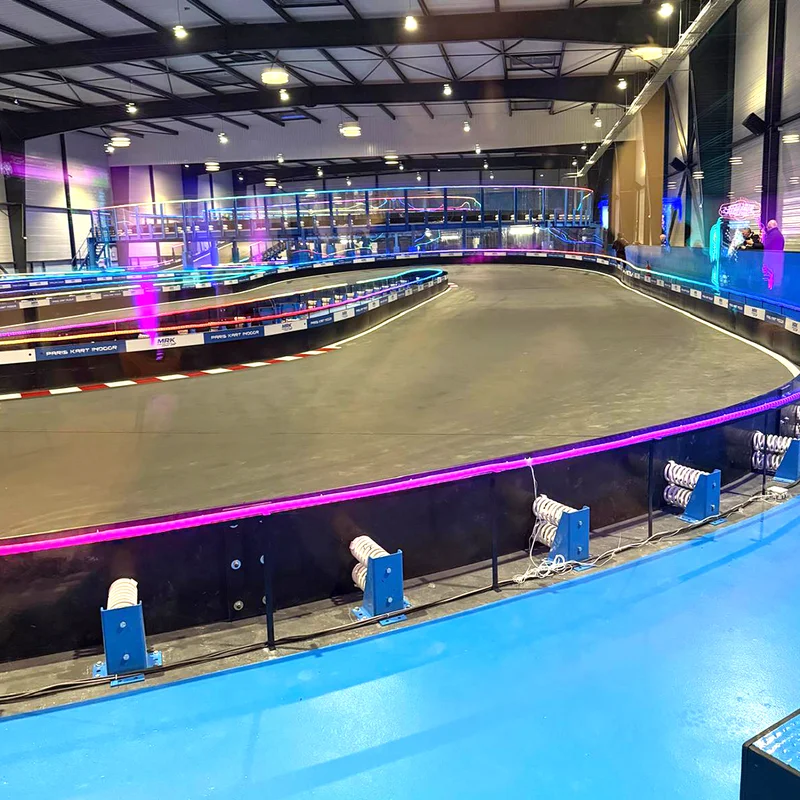
A resin quotation identifies what will be supplied. An application record explains what was actually used, where and under which recorded conditions. For an indoor karting project, that link can make a later maintenance discussion much more precise: instead of saying “the floor near the bridge”, the operator can refer to a marked zone, the product batch and the work record. Prepare the register before the coating arrives, while the drawing and the division of responsibilities are still easy to agree.
Start with a zone map the applicator can use
Divide the surfaces into identifiable work areas on a dated drawing. Give each area a short code and show where it starts and ends. Separate ground-level track, elevated deck, pit area and any other treatment included in the project. A drawing that shows quantities for the quotation can provide the starting point, but add the actual boundaries agreed for the work. A zone is a location reference; it does not establish a suitable construction joint or stopping point. Ask the applicator to confirm those details for the chosen system.
Keep preparation and coating records linked to the same zone code. If an area changes after a site discovery, retain the previous drawing and issue a revised map. Photograph the boundaries and any local feature the team will need to find again. Do not replace the measured area with a guessed quantity from the number of containers used.
Record the product actually delivered
At delivery, record the product name, component identification, batch numbers, labelled quantities and the condition of the packaging. Keep a photograph of each relevant label. Where a system has separate components, give the record space for both rather than assigning one batch number to the whole delivery. MRK’s published technical sheet describes its water-based epoxy coating as a two-component system. Obtain the current technical and safety documents for the product supplied before work starts.
Record the revision or date of the instructions the applicator will use, and identify who is responsible for checking them with MRK. The register should refer to the confirmed mixing, preparation and application procedure; it should not invent a ratio, a working time or a dilution allowance. If another product or reference arrives, resolve the difference before treating it as an approved substitution.
Link each work entry to its area and time
Ask the applicator which readings and checks the selected system requires and how they will be measured. Prepare fields for the substrate condition, relevant environmental readings, measurement location and time, instrument or method, and the person making the entry. Keep the actual readings separate from the acceptance criteria taken from the confirmed instructions. A blank box means information is missing; it must not be interpreted as an acceptable result.
For each application entry, record the zone, component batches, start and finish times, quantity used, application stage and any interruption. If one batch serves several zones, link all of them to the same entry. If a zone needs a local repair or another application stage, add a new entry without overwriting the earlier one. Describe deviations and the written instruction that resolved them. This is a traceability aid, not proof that the coating has achieved a particular performance.
Use a small example to test the register
Consider a fictional refurbishment with zones G1, the ground-level straight, and P1, the pit approach. The applicator uses the same component batches in both areas, then stops before P1 is complete. One product record can link to two application entries, while the next visit receives its own date, readings and remaining area. A photograph showing the stopping boundary helps the team understand the record later. No quantity, curing interval or reopening date can be inferred from these invented zone names.
At handover, reconcile delivered, used, remaining and returned materials using compatible units, with the applicator explaining any differences. Identify the separately confirmed instructions for maintenance and return to service. MRK’s resin page explicitly distinguishes drying data from a guaranteed reopening time. Do not turn a completed log or a dry-looking surface into authorisation to run karts.
Make the record part of the agreed scope
State who supplies the resin, arranges transport, receives and stores it, prepares the substrate, applies the system and compiles the record. Ask whether preparation, application, measurements, waste handling and handover documents are included or priced separately. Keep taxes and any transport or installation charges explicit in the quotation. A material allowance in a simulator does not establish the complete site application scope.
Use the MRK track resin page to start the product discussion and the coating quantity drawing guide to prepare the areas. For wider interfaces, see track design and construction. You can explore the public price simulator, then request a project-specific quotation with the substrate description, zone drawing, intended works and responsibility list.
Before application starts
- A dated zone drawing with agreed work boundaries.
- Product and component labels linked to batch records.
- Current instructions and required checks confirmed with the supplier.
- A named owner for the application log and handover file.
- Separate confirmation of maintenance and return-to-service conditions.
Sources and related guidance
- MRK technical sheet, French: public document based on technical source data dated October 2019; confirm the current instructions for the supplied product.
- MRK resin product page, including the distinction between drying and return to service.
- General surface preparation and coating guide.
Sources consulted on 19 November 2026. The register is a proposed project tool, not a manufacturer-issued application procedure.